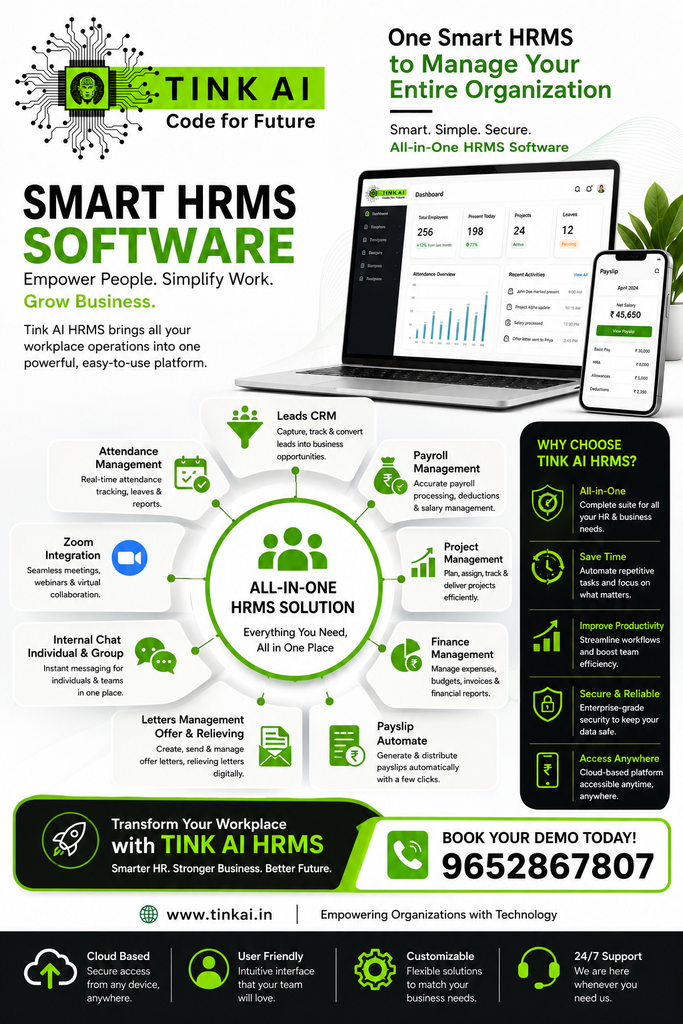
We deliver smart solutions in Business Connect, Digital Marketing, Web Development, Recruitment, Payroll & HR Services, LMS, Resume Builder, and CRT Trainings to boost productivity and innovation.
Best HRMS Software in India can help businesses simplify employee management, automate HR processes, reduce paperwork, and improve workforce productivity. From startups and small businesses to large enterprises, modern organizations need a centralized HR platform to manage attendance, payroll, leave, recruitment, employee records, performance, and compliance.
Traditional HR processes often depend on spreadsheets, manual calculations, emails, and multiple disconnected applications. An HRMS (Human Resource Management System) brings these activities together in one digital platform, helping HR teams save time and reduce errors.
With the growing adoption of cloud-based business applications, choosing the right HRMS software has become an important decision for organizations looking to build an efficient and scalable HR operation.
What Is HRMS Software?
HRMS stands for Human Resource Management System. It is software designed to manage and automate different HR activities through a centralized platform.
Depending on the solution, an HRMS Software can include:
Employee Management
Attendance Management
Leave Management
Payroll Management
Recruitment Management
Application Tracking System
Performance Management
Employee Self-Service
Document Management
HR Reports and Analytics
Expense Management
Task and Project Management
Automated Letters and Payslips
Instead of maintaining employee information across multiple files, businesses can use one HRMS platform to manage employee data and daily HR operations.
Why Businesses Need the Best HRMS Software in India
Indian businesses have diverse workforce-management requirements. Managing employees manually becomes increasingly difficult as the organization grows.
The Best HRMS Software in India can help organizations:
1. Automate HR Processes
Routine HR activities such as attendance calculation, leave processing, payroll preparation, and employee documentation can be automated.
2. Reduce Manual Errors
Automated calculations and centralized employee information can reduce errors caused by manual data entry and spreadsheet-based processes.
3. Improve Employee Experience
Employees can access their attendance, leave balances, payslips, documents, and other HR information through employee self-service features.
4. Save HR Time
HR teams can spend less time performing repetitive administrative activities and more time focusing on employee engagement and business growth.
5. Centralize Employee Information
A centralized HRMS allows authorized users to access employee information from a single system.
Key Features of the Best HRMS Software in India
When comparing HRMS Software, businesses should evaluate the features that match their organizational requirements.
Employee Management
Employee management is the foundation of an HRMS Software. Businesses can maintain employee profiles, departments, designations, joining information, documents, employment details, and other important records.
Attendance Management
Modern HRMS solutions can help organizations track employee attendance, working hours, late arrivals, early departures, shifts, and attendance regularization.
Integration with biometric devices and other attendance systems can further automate workforce tracking.
Leave Management
Employees can submit leave requests digitally while managers can approve or reject requests through the system. HR teams can configure different leave types and monitor leave balances.
Payroll Management
Payroll automation can simplify salary calculations, deductions, allowances, payslip generation, and payroll reports.
Businesses operating in India should also evaluate whether the HRMS supports their required payroll and statutory workflows.
Recruitment and ATS
Recruitment features can help HR teams manage job openings, candidates, interviews, recruitment stages, and hiring workflows.
An integrated Application Tracking System (ATS) can make it easier to organize candidate information and monitor applications.
Performance Management
Performance management modules can support goal setting, reviews, employee assessments, feedback, and performance tracking.
Employee Self-Service
Employee self-service reduces dependency on HR for routine requests. Employees can potentially access:
Payslips
Leave balances
Attendance information
Company documents
Profile information
Leave applications
Attendance regularization
HR Reports and Analytics
HR analytics can help management understand workforce trends and make data-driven decisions.
Common reports include:
Attendance Reports
Payroll Reports
Employee Reports
Leave Reports
Recruitment Reports
Department Reports
Performance Reports
How to Choose the Best HRMS Software in India
Choosing HR software should not be based only on the number of features. Businesses should consider usability, scalability, integrations, security, pricing, and support.
1. Understand Your HR Requirements
First identify the processes you want to automate. A small business may primarily need employee management, attendance, leave, and payroll, while a larger organization may require recruitment, performance management, finance, and analytics.
2. Check Scalability
The HRMS Software should be capable of supporting your organization as the employee count and business operations grow.
3. Evaluate Ease of Use
An HRMS Software should be easy for HR administrators, managers, and employees to use. A complicated interface can reduce adoption.
4. Review Integrations
Check whether the software can integrate with attendance devices, payroll systems, communication tools, accounting platforms, or other business applications used by your organization.
5. Consider Security
Employee information is sensitive business data. Organizations should evaluate access controls, authentication, backups, data protection, and other security measures before selecting an HRMS Software.
6. Compare Pricing
Compare pricing based on employees, modules, implementation costs, integrations, support, and additional services rather than looking only at the advertised starting price.
Cloud-Based HRMS Software vs Traditional HR Management
Traditional HR management often involves spreadsheets, paper records, emails, and multiple standalone applications. This approach can become difficult to maintain as the workforce grows.
Cloud-based HRMS platforms provide centralized access to HR information and can allow authorized users to access the system from different locations.
For organizations with multiple branches or remote employees, cloud-based HRMS Software can provide greater flexibility and centralized management.
Benefits of HRMS Software for Small and Medium Businesses
HRMS Software is not limited to large enterprises. Small and medium-sized businesses can also benefit from HR automation.
A suitable HRMS Software can help smaller organizations:
Maintain organized employee records
Automate attendance
Simplify payroll
Manage employee leave
Improve recruitment workflows
Generate HR reports
Reduce paperwork
Improve employee communication
Standardize HR processes
As businesses expand, an HRMS can provide a structured foundation for managing their growing workforce.
Best HRMS Software in India: What Should You Look For?
The right solution depends on your company’s size, industry, workforce, budget, and HR requirements.
Before selecting the Best HRMS Software in India, create a checklist covering:
Employee database
Attendance
Leave
Payroll
Recruitment
ATS
Performance management
Employee self-service
Reports and analytics
Mobile accessibility
Multi-branch support
Integrations
Security
Customer support
Pricing and scalability
A HRMS Software that offers the right combination of features and usability can deliver more value than software with a large number of unnecessary modules.
HRMS Software and Digital Transformation
HRMS Software is becoming an important part of business digital transformation. By moving HR processes from manual systems to centralized digital platforms, organizations can improve operational efficiency and gain better visibility into workforce data.
HRMS Software Automation also allows HR professionals to spend more time on strategic activities such as employee engagement, talent development, workforce planning, and organizational growth.
Final Thoughts
The Best HRMS Software in India should make HR operations simpler, more organized, and more efficient. Businesses should evaluate software based on their actual HR requirements rather than selecting a platform solely because it has a long list of features.
Whether you are a startup, SME, growing company, or large enterprise, implementing the right HRMS Software can help automate employee management, attendance, leave, payroll, recruitment, performance, and reporting.
Before making a final decision, request a product demonstration, evaluate the key modules, understand the pricing model, check scalability and security, and confirm that the software can support your organization’s future requirements.

 By Support
August 24, 2026
By Support
August 24, 2026